
Dry-Type Transformer: Characteristics, Ratings, Trade-offs, and Applications

Introduction: What a Dry-Type Transformer Is
A dry-type transformer uses no liquid insulation medium. The core and windings dissipate heat through air convection, and the windings rely on solid insulation materials—cast resin encapsulation or vacuum pressure impregnation—to form the insulation system. This “oil-free” characteristic is the starting point for every engineering property of a dry-type transformer: it eliminates the fire risk associated with combustible liquids and removes the ongoing burden of oil maintenance. The costs appear in cooling efficiency, overload margin, and cost per unit capacity.
A dry-type transformer is not a “simplified substitute for an oil-immersed unit.” It fills roles that oil-immersed equipment cannot serve effectively in fire-compliance, indoor-installation, and low-maintenance-driven applications. We have broken down the item-by-item comparison between the two technologies—fire path, TCO, maintenance regime, and capacity boundaries—in a separate selection guide:
Oil-Immersed Transformer vs Dry-Type Transformer: A Complete Selection Guide for Project Decisions.
This article focuses on the dry-type transformer itself: what range it covers, under what conditions it earns its place, and which engineering variables require confirmation before selection.
1. Mainstream Voltage and Capacity Ranges
The specification envelope of a dry-type transformer requires distinguishing between the standard-defined ceiling and the actual mainstream commercial range. The two are not identical.
1.1 Standard range
IEC 60076-11 applies to dry-type power transformers with a highest voltage for equipment up to and including 72.5 kV, provided at least one winding operates above 1.1 kV. China’s GB/T 1094.11-2022 adopts the same voltage ceiling. This sets the standard-level capability ceiling for dry-type transformers.
1.2 Mainstream commercial products
The vast majority of dry-type transformers concentrate at the medium-voltage distribution level. A typical cast-resin dry-type transformer covers 6.6 kV to 36 kV, with capacities from 100 kVA to 25 MVA as a manufacturing capability ceiling. Distribution dry-type transformers commonly span 10–35 kV / 30–2500 kVA, with Dyn11 as the typical vector group, 4%–6% short-circuit impedance, and F or H insulation class. Certain series extend to 10,000 kVA.
A boundary to recognize: 72.5 kV is the standard-permitted ceiling, but actual commercial products concentrate at 36 kV and below. Higher-voltage products fall into the customized category rather than standard catalog offerings. On capacity, 25 MVA reflects certain manufacturers’ engineering capability ceiling; routine distribution demand remains within 2500 kVA.
2. Advantages: The Compliance and O&M Dividend of Being Oil-Free
The competitiveness of a dry-type transformer does not come from a single peak performance metric. It comes from how the fact of “no oil” projects onto fire compliance, installation flexibility, and maintenance burden.
2.1 Shortest fire-compliance path
A dry-type transformer contains no combustible liquid, and its insulation materials are flame-retardant or self-extinguishing. The National Electrical Code (NFPA 70 / NEC 450) for indoor dry-type installations centers on clearance from combustible materials and fire-rated separation, not the oil containment and suppression systems required for oil-immersed equipment. Indoor dry-type transformers rated at 112.5 kVA or less require a minimum 305 mm (12 in.) separation from combustible material; above that rating, under certain building conditions, installation inside a room with a fire rating of at least three hours is required. These requirements are deterministic and designable, and they avoid the additional civil works associated with oil containment and suppression in oil-immersed projects.
2.2 Partial discharge control as a hard manufacturing metric
IEC 60076-11 specifies a partial discharge threshold of below 10 pC for new cast-resin dry-type transformers, and 50 pC for resin-encapsulated windings. This limit is far stricter than typical partial discharge levels in many oil-immersed products. For data centers, hospitals, and other applications demanding high insulation reliability, low partial discharge is direct evidence of manufacturing precision and long-term insulation stability.
2.3 Minimal maintenance burden
A dry-type transformer requires no oil sampling, DGA, oil filtration, or waste-oil disposal. Core maintenance activities center on cleaning, infrared thermography, and ventilation inspection. For projects with thin O&M teams or an intention to outsource maintenance, this characteristic significantly reduces lifecycle organizational cost.
2.4 Mature and clearly differentiated technology routes
Cast resin held approximately 67% of the dry-type transformer market in 2025, with VPI (vacuum pressure impregnation) at about 26% and growing at a faster rate. Cast resin leads on moisture resistance, fire performance, and short-circuit strength; VPI offers advantages in heat dissipation, overload capability, and initial cost, with certain designs allowing more convenient repair. This differentiation creates room for matching technology route to project conditions, rather than treating one design as universally applicable.
3. Disadvantages: The Real Costs of Air-Cooling Physics
The shortfalls of a dry-type transformer follow directly from the physical fact of using air instead of liquid for heat dissipation.
3.1 A structural premium on initial cost
Dry-type transformers typically carry a 40%–70% price premium over same-rating oil-immersed equivalents, with the exact gap depending on rating, technology route, and certification requirements. Cast-resin tooling, vacuum casting and curing processes, and the cost of solid insulation materials drive the premium. For projects extremely sensitive to initial CAPEX where fire constraints do not create a bottleneck, the oil-immersed purchase-price advantage is structural.
3.2 Overload capability limited by air’s heat capacity
Liquid has far higher heat capacity and thermal conductivity than air, and the thermal inertia of an oil-immersed unit allows short-time overload without immediately reaching the hot-spot limit. A dry-type transformer has a shorter thermal time constant and a correspondingly narrower overload margin. Certain cast-resin products provide approximately 40% short-time capacity boost under forced air cooling (AF), but this depends on fan operation and still does not equal the thermal inertia reserve of an oil-immersed design.
3.3 Uncertainty in noise performance
Reported noise levels for dry-type transformers vary across sources: some give a 50–60 dB range, while other comparisons indicate cast-resin units may run 3–6 dB higher than oil-immersed equivalents. The variation reflects the combined effect of core magnetostriction, cooling-fan operation, and enclosure acoustic design. For noise-sensitive locations, “low noise” cannot serve as a qualitative promise; the basis must be measured sound power or sound pressure level for the selected model under the target cooling mode.
3.4 Non-repairability of cast-resin windings
Once a cast-resin winding cures, the coil cannot be removed from the core. Internal failure typically means complete replacement rather than on-site repair. VPI designs offer better serviceability on this dimension, but the moisture resistance and fire performance advantages of cast resin come at the cost of that flexibility.
4. Main Application Scenarios
The engineering attributes of a dry-type transformer—oil-free, short fire-compliance path, low maintenance, controllable partial discharge—match a set of applications with rigid requirements for indoor installation, occupant safety, and O&M simplicity.
4.1 Data centers
This is currently the strongest growth driver for dry-type transformers. Conventional oil-immersed transformers have fallen below 35% of new large data center installations due to environmental compliance costs and safety restrictions, while cast-resin dry-type units hold approximately 65% of the new-build market. High power-density racks and indoor fire constraints together position dry-type transformers as the default in this application.
4.2 Hospitals and healthcare buildings
Medical facilities demand both low fire risk and supply continuity. The oil-free nature of dry-type transformers eliminates oil leakage and fire spread risk, while low partial discharge and low maintenance align with expectations for reliability and O&M simplicity.
4.3 Rail transit and underground spaces
Subway and light-rail underground stations and tunnels have enclosed spaces with constrained ventilation and firefighting conditions. The flame-retardant characteristics and smaller clearance requirements of dry-type transformers make them a fitting choice for underground traction and auxiliary power.
4.4 High-rise buildings and commercial complexes
Building interiors cannot provide the space for oil containment and suppression infrastructure. Dry-type transformers can sit directly in distribution rooms near load centers, shortening low-voltage cable runs and reducing line losses.
4.5 Indoor auxiliary applications at renewable energy sites
Wind and solar box-type step-up transformers predominantly use oil-immersed designs, but station-service and control-power transformers at these sites often sit indoors or in enclosed compartments, where the oil-free and low-maintenance characteristics of dry-type units carry practical value.
4.6 Industrial indoor environments with relaxed noise limits
Certain industrial plants tolerate higher noise than commercial or residential settings and do not permit oil-immersed equipment under fire approval. A dry-type transformer provides a compliant and low-maintenance option in these locations.
A boundary reminder: If the project’s binding constraints are lowest initial cost, high overload margin, or outdoor large-capacity application, an oil-immersed transformer remains the better-matched technology route. The dry-type advantage is not “universally superior to oil-immersed.” It is the fire-compliance certainty, low maintenance burden, and indoor installation flexibility that come from being oil-free. The full comparison logic appears in
Oil-Immersed Transformer vs Dry-Type Transformer: A Complete Selection Guide for Project Decisions.
5. Three Things to Confirm Before Selection
5.1 Fire-code requirements and clearance conditions at the installation site
Will the transformer sit inside a building, in a basement, or in a dedicated electrical room? What clearance and fire-separation requirements do local codes impose on dry-type units? For indoor dry-type transformers above 112.5 kVA, is a three-hour fire-rated room required? These answers directly determine the installation scheme and civil cost, not merely the transformer selection itself.
5.2 Technology route alignment
Does the project prioritize moisture resistance and fire performance (cast resin), or overload capability and serviceability (VPI)? Does the non-repairability of cast resin align with the project’s O&M strategy? Does VPI’s cooling advantage carry practical value under the project’s load profile? The choice of technology route is not about which is “more advanced”; it is about which matches the project constraints more closely.
5.3 Measured noise data
If the installation sits near a noise-sensitive area, request measured noise data for the selected model under the target cooling mode (AN or AF) rather than accepting a qualitative “low noise” description. Fan operation significantly changes noise level, and AN and AF conditions require separate confirmation.
Conclusion
The value of a dry-type transformer is not “replacing oil-immersed in every scenario.” It is trading the oil-free design for fire-compliance certainty, minimal maintenance burden, and indoor installation flexibility. These advantages hold strongest in data centers, hospitals, rail transit, high-rise buildings, and commercial complexes—applications with rigid requirements for occupant safety and O&M simplicity. The costs are equally clear: higher initial cost, narrower overload margin, and sensitivity to cooling conditions are engineering variables that must be honestly priced during selection.
A practical order of judgment: first confirm whether the installation’s fire constraints require oil-free equipment; then assess whether the load profile demands the overload margin of an oil-immersed unit; finally, complete the selection with technology-route matching and measured noise data. Recommending oil-immersed without checking fire constraints, and comparing initial unit prices while ignoring overload needs, are two directions of the same decision bias.
 Oil-Immersed Transformer: Characteristics, Ratings, Trade-offs, and Applications
Share This Article, Choose Your Platform!
Related News
Introduction: What a Dry-Type Transformer Is A dry-type transformer uses no liquid insulation medium. The core and windings dissipate heat through air convection, and the windings rely on solid insulation materials—cast resin encapsulation or vacuum pressure impregnation—to form the insulation system. This “oil-free” characteristic is the starting point for every engineering property of a dry-type [...]
Introduction: What an Oil-Immersed Transformer Is In engineering standards and global project specifications, the more precise umbrella term for this equipment is a Liquid-immersed transformer. It immerses the core and windings in insulating liquid, with the liquid serving both insulation and heat-transfer functions. Oil-immersed transformer is the most widely used and heavily searched industry term, [...]
Introduction: What a 3D Wound Transformer Is A Three-dimensional Wound Transformer—commonly shortened to 3D Wound Transformer—assembles three identically wound core frames into an equilateral triangular three-dimensional magnetic circuit. Each frame uses continuously wound silicon steel or amorphous ribbon, and after assembly the three limbs carry exactly equal magnetic path lengths, with flux traveling along the rolling [...]
Introduction: What a Laminated Core Transformer Is A Laminated Core Transformer builds its core from thin sheets of cold-rolled grain-oriented silicon steel (CRGO), cut and stacked layer by layer. Sheet thickness typically ranges from 0.23 mm to 0.35 mm, and each sheet carries an insulating coating that prevents eddy currents from forming large loops through [...]
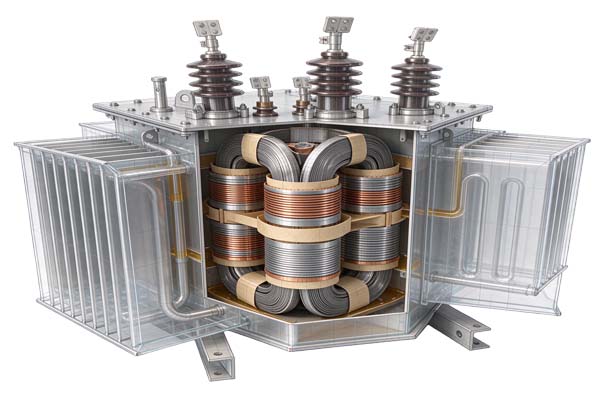
Introduction: What a Silicon Steel Transformer Is A Silicon Steel Transformer uses cold-rolled grain-oriented silicon steel (CRGO) as its core material. Silicon steel is a low-carbon iron alloy containing roughly 3% silicon; cold rolling and annealing align the grains along the rolling direction, creating a “grain-oriented” structure. This structure allows magnetic flux to pass more [...]
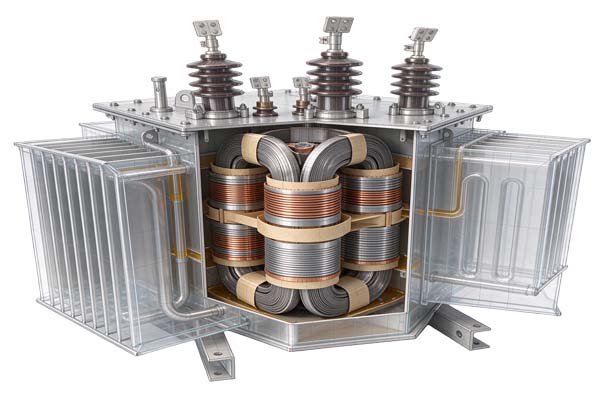
Introduction: What an Amorphous Alloy Transformer Is An Amorphous Alloy Transformer uses iron-based amorphous alloy ribbon instead of conventional cold-rolled grain-oriented silicon steel as its core material. The fundamental difference lies in atomic structure. Silicon steel has an ordered crystalline lattice; when magnetic flux reverses, domain walls must overcome grain boundaries, generating hysteresis loss. Amorphous [...]