
Oil-Immersed Transformer vs Dry-Type Transformer: A Complete Selection Guide for Project Decisions丨MeteniquePower

Introduction: The Wrong Choice Costs More Than the Purchase Order
The choice between an oil-immersed transformer and a dry-type transformer directly determines a project’s fire-safety design path, civil construction cost, maintenance regime, and lifetime energy-loss structure. Many projects compare only the initial quotation at procurement, then discover after commissioning that the fire-rated vault, oil containment pit, and suppression systems required for an oil-immersed transformer can consume the entire price advantage it held over a dry-type alternative. Conversely, in a humid or dusty outdoor environment, a dry-type transformer without a properly conditioned enclosure can age faster than expected.
This article does not recommend “which type is better.” It works through project conditions in sequence: first installation location and fire constraints, then capacity and load profile, and finally the combined arithmetic of initial cost and operating losses. Readers can jump directly to the decision section that matches their project constraints.
1. The Fundamental Difference: Insulation and Cooling Medium Set Everything Else
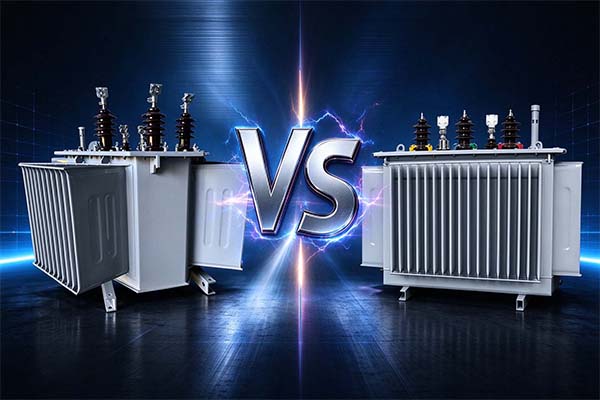
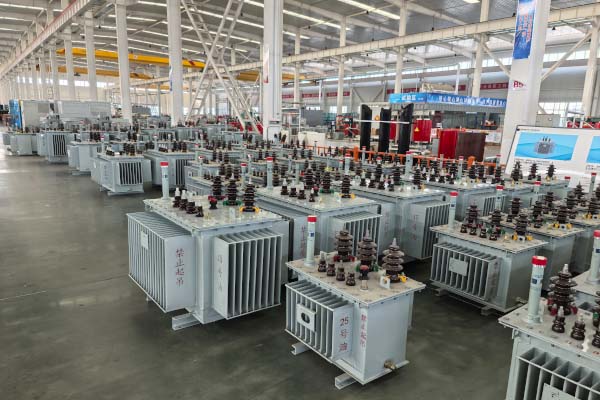
An oil-immersed transformer immerses the core and windings in mineral oil or synthetic ester, where the liquid serves both insulation and heat-transfer functions. A dry-type transformer uses air—natural convection or forced ventilation—as the cooling medium, combined with cast-resin or VPI solid insulation, and contains no flammable liquid.
This medium difference is the root of every downstream distinction: fire-compliance path, maintenance content, environmental tolerance, and capacity ceiling all follow from it. Both types must meet the basic performance requirements of the IEC 60076 series, but their operating characteristics diverge significantly in specific applications.
2. Safety: The Decisive Variable for Indoor Sites
Safety is the dimension where the two types diverge most sharply, and it is the first item most modern indoor projects evaluate.
An oil-immersed transformer uses a flammable liquid. Mineral oil has a relatively low flash point and fire point. If a bushing failure or seal breach ignites the oil, fire can spread to adjacent equipment. As a result, in building interiors, basements, hospitals, schools, and high-rises, an oil-immersed transformer typically requires fire-rated separation, oil containment pits, and suppression systems—added civil and fire-protection costs that must enter the total project budget.
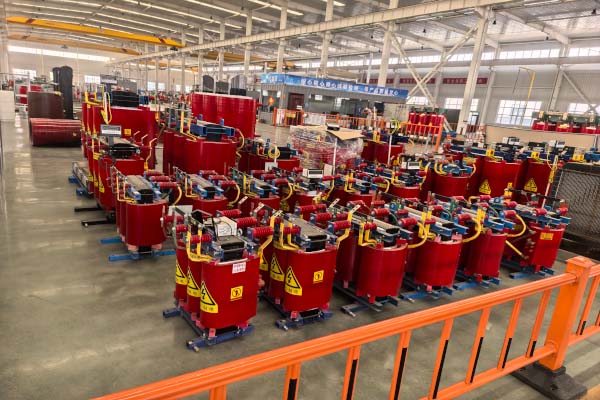
A dry-type transformer—particularly with cast-resin or VPI windings—is self-extinguishing and contains no flammable liquid. It produces no toxic smoke when exposed to fire. The National Electrical Code (NFPA 70) permits indoor installation of a dry-type transformer with minimal clearance, without the fire-rated vault and oil-containment infrastructure that liquid-filled units demand. For occupied buildings or sites with strict fire-approval processes, this difference often settles the selection on its own.
Conditional rule: If the transformer sits inside an occupied or working building, the dry-type transformer offers the shortest compliance path and the lowest aggregate risk. If it sits in an outdoor substation remote from buildings, the oil-immersed transformer remains safe under proper maintenance, and its lower initial cost is real.
3. Initial Cost vs. Total Cost of Ownership: Two Different Ledgers
At the same rating, an oil-immersed transformer typically carries a lower purchase price. 2025–2026 FOB China pricing shows a 500 kVA oil-immersed unit at roughly $5,500–$7,500, against $7,500–$10,500 for an equivalent dry-type unit. At 1000 kVA, a dry-type transformer costs nearly 1.5 times the oil-immersed price.
Two factors recalibrate this gap at the project level.
First, indoor civil and fire-protection cost. If the oil-immersed transformer requires a fire-rated vault, oil containment pit, and suppression system to satisfy code, that investment directly erodes its purchase-price advantage. In some indoor projects, the all-in cost of the oil-immersed option, including fire infrastructure, matches or exceeds the dry-type alternative.
Second, the long-run difference in operating losses. Under identical duty, a dry-type transformer typically carries 15%–20% higher comprehensive losses than an oil-immersed transformer. The liquid cooling medium is more thermally efficient, making oil-immersed units better suited to continuous heavy-load duty; dry-type transformers perform relatively better under partial load. This means: if the load stays near rated capacity for long periods, the oil-immersed unit’s energy-cost advantage accumulates year by year; if the load factor is low or operating hours are limited, the gap narrows substantially.
Conditional rule: Do not compare “price per kVA” in isolation. Put fire-infrastructure cost and estimated annual loss cost based on the actual load profile into the same TCO sheet. Only then does it become clear which type is genuinely “cheaper” for your project.
4. Maintenance Regime: Oil Management vs. Cleaning and Inspection
An oil-immersed transformer requires an oil-maintenance regime: periodic oil sampling for dissolved gas analysis (DGA), oil dielectric strength and moisture testing, seal and radiator inspection, and filtration or oil replacement when needed. A hermetically sealed design significantly reduces oil-to-air contact and lowers maintenance frequency, but the logic of oil-condition monitoring itself does not disappear. For projects with a thin O&M team or remote locations, this is a continuing organizational burden.
A dry-type transformer demands far less: cleaning and infrared thermography are the core activities. It requires no oil sampling, oil processing, or waste-oil disposal. For sites with restricted maintenance access, or where the owner intends to outsource O&M to a non-specialist team, the low-maintenance character of the dry-type unit is an underestimated practical advantage.
Conditional rule: If the project lacks oil-laboratory O&M capability, or the owner explicitly wants a “low-maintenance burden,” the weight of the dry-type transformer rises significantly. If the site has a mature substation O&M system, the oil-immersed maintenance regime is more extensive but well-established, with broad availability of spares and testing resources.
5. Capacity Range and Voltage Class: The Hard Boundaries
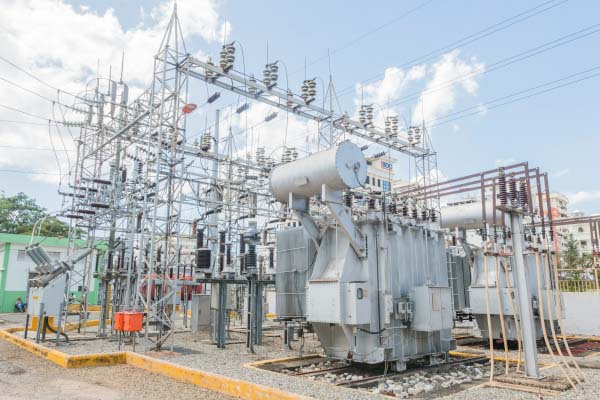
The oil-immersed transformer covers a far wider capacity and voltage envelope. Distribution-class oil-immersed products span from tens of kVA to several MVA, while power-class units reach tens to hundreds of MVA, with voltage classes up to 765 kV. This makes oil-immersed the default technology for transmission, generator step-up, and large industrial load applications.
The dry-type transformer typically covers an economical capacity range from tens of kVA to several thousand kVA (indoor distribution commonly up to 2,500–4,000 kVA), with voltage classes concentrated at 35 kV and below, and some products extending to 72 kV. Beyond this envelope, the physical constraints of air cooling and solid insulation become pronounced.
Conditional rule: If the project capacity exceeds several MVA, or the voltage class is above 35–72 kV, the oil-immersed transformer is the more realistic engineering choice. The dry-type advantage concentrates in medium- and low-voltage, small-to-medium capacity, indoor or fire-sensitive distribution applications.
6. Environmental Tolerance: A Practical Look at Outdoor and Harsh Climates
The tank and liquid-circulation system of an oil-immersed transformer tolerate outdoor dust, temperature swings, wind, and snow more robustly. In a hermetically sealed design, the oil is isolated from external air, further reducing moisture ingress risk. In hot, dusty, or coastal environments, the oil-immersed option generally outlasts an unprotected dry-type unit.
The core environmental weakness of a dry-type transformer is humidity and conductive dust. When installed outdoors or in an uncontrolled industrial setting, it must have an appropriate enclosure (IP54 or higher) and a defined ventilation strategy; otherwise, moisture or dust on insulation surfaces can significantly increase creepage and partial-discharge risk. In a clean, temperature- and humidity-controlled indoor space, this weakness does not materialize.
Conditional rule: For outdoor or harsh-climate locations, evaluate the oil-immersed transformer first (or a sealed dry-type unit with a high-protection enclosure). In a clean indoor environment, the dry-type environmental weakness is irrelevant, and its fire-safety and low-maintenance advantages dominate.
7. Decision Checklist: Eliminate by Project Condition
The checklist below follows a hard-constraint-first order. If any item matches, place the corresponding type at the top of the shortlist, then use TCO data for the final commercial judgment.
Conditions favoring a dry-type transformer:
1.The installation sits inside a building, basement, high-rise, hospital, school, data center, or occupied space.
2.Fire codes require no flammable liquid, or the owner/insurer restricts oil-filled equipment.
3.The project seeks to minimize oil-related maintenance, or lacks oil-testing O&M resources.
4.Capacity is within several thousand kVA, and voltage class is 35 kV or below.
5.The environment is a clean, temperature- and humidity-controlled indoor space.
Conditions favoring an oil-immersed transformer:
1.The installation is an outdoor substation or dedicated equipment yard, remote from occupied buildings.
2.Capacity is several MVA or above, or voltage class is above 35–72 kV.
3.The load profile is continuous heavy duty, and long-term loss cost outweighs the initial price gap.
4.The site has a mature oil-maintenance O&M system, or adopts a hermetically sealed design to reduce maintenance frequency.
5.The environment is hot, dusty, coastal, or subject to large temperature swings, without a climate-controlled enclosure.
6.Initial CAPEX is a hard constraint, and fire-infrastructure cost falls outside the project scope.
Conclusion
Neither the oil-immersed transformer nor the dry-type transformer is universally superior. Selection is not a comparison of product labels. It is a sequence: first lock installation location and fire constraints; then test capacity and voltage against the hard boundaries; finally, complete the commercial decision using TCO data that includes fire infrastructure and operating losses.
A practical order of judgment: indoor or fire-sensitive → dry-type first; outdoor, large-capacity, or continuous heavy-load → oil-immersed first; when both are viable, use the loss differential under the actual load profile and the fire-infrastructure cost to make the final comparison.
Know More
» Dry-Type Transformer: Characteristics, Ratings, Trade-offs, and Applications
» Oil-Immersed Transformer: Characteristics, Ratings, Trade-offs, and Applications
» Silicon Steel Transformer vs Amorphous Alloy Transformer
» Laminated Core Transformer vs Three-Dimensional Wound Core Transformer
 Transformer Manufacturer for Power, Distribution &Special Applications 丨MeteniquePower
 Laminated Core Transformer vs Three-Dimensional Wound Core Transformer: How Magnetic Path Structure Drives Loss, Noise, and Lifetime Cost
Share This Article, Choose Your Platform!
Related News
Introduction: What a Dry-Type Transformer Is A dry-type transformer uses no liquid insulation medium. The core and windings dissipate heat through air convection, and the windings rely on solid insulation materials—cast resin encapsulation or vacuum pressure impregnation—to form the insulation system. This “oil-free” characteristic is the starting point for every engineering property of a dry-type [...]
Introduction: What an Oil-Immersed Transformer Is In engineering standards and global project specifications, the more precise umbrella term for this equipment is a Liquid-immersed transformer. It immerses the core and windings in insulating liquid, with the liquid serving both insulation and heat-transfer functions. Oil-immersed transformer is the most widely used and heavily searched industry term, [...]
Introduction: What a 3D Wound Transformer Is A Three-dimensional Wound Transformer—commonly shortened to 3D Wound Transformer—assembles three identically wound core frames into an equilateral triangular three-dimensional magnetic circuit. Each frame uses continuously wound silicon steel or amorphous ribbon, and after assembly the three limbs carry exactly equal magnetic path lengths, with flux traveling along the rolling [...]
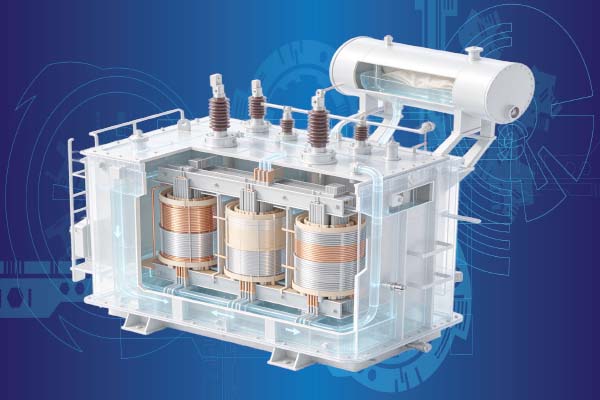
Introduction: What a Laminated Core Transformer Is A Laminated Core Transformer builds its core from thin sheets of cold-rolled grain-oriented silicon steel (CRGO), cut and stacked layer by layer. Sheet thickness typically ranges from 0.23 mm to 0.35 mm, and each sheet carries an insulating coating that prevents eddy currents from forming large loops through [...]
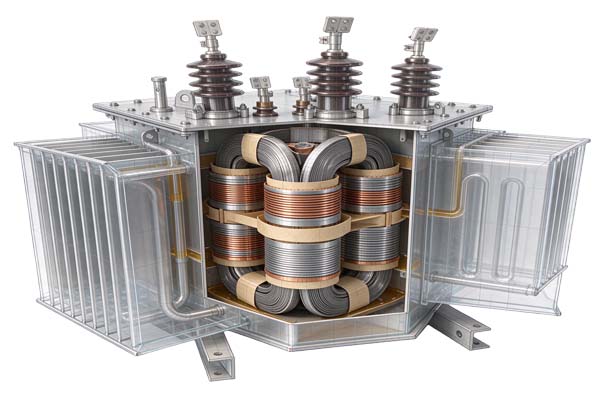
Introduction: What a Silicon Steel Transformer Is A Silicon Steel Transformer uses cold-rolled grain-oriented silicon steel (CRGO) as its core material. Silicon steel is a low-carbon iron alloy containing roughly 3% silicon; cold rolling and annealing align the grains along the rolling direction, creating a “grain-oriented” structure. This structure allows magnetic flux to pass more [...]
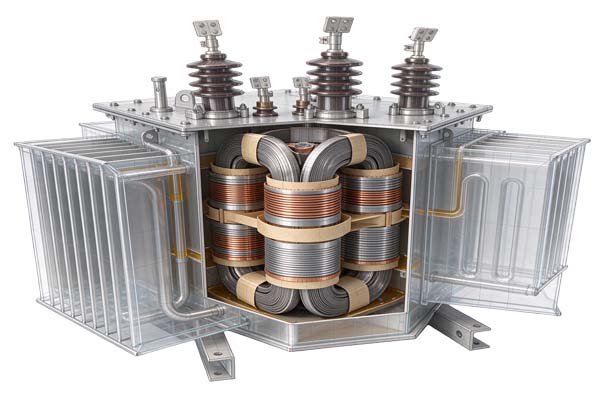
Introduction: What an Amorphous Alloy Transformer Is An Amorphous Alloy Transformer uses iron-based amorphous alloy ribbon instead of conventional cold-rolled grain-oriented silicon steel as its core material. The fundamental difference lies in atomic structure. Silicon steel has an ordered crystalline lattice; when magnetic flux reverses, domain walls must overcome grain boundaries, generating hysteresis loss. Amorphous [...]